

Walk into almost any open-plan office and you’ll encounter an invisible problem: noise. The clatter of keyboards, the low hum of ventilation systems, the colleague three desks away who seems to take every phone call on speaker — it all adds up. But workplace acoustics isn’t just about annoyance. There’s a genuine, well-researched science behind how sound behaves in built environments, and its effects on human performance, wellbeing, and even physical health are more significant than most people realise.
Understanding the mechanics of sound in office spaces — and what can be done to manage it — is increasingly relevant as organisations wrestle with hybrid working models, open-plan layouts, and the challenge of designing spaces where people can actually think clearly.
What Is Workplace Acoustics?
Acoustics, in its broadest sense, is the science of sound — how it’s produced, transmitted, and received. In the context of a workplace, acoustics refers to the way sound behaves within a built environment: how it travels across open floors, reflects off hard surfaces, absorbs into soft materials, and ultimately reaches (or fails to reach) human ears in a useful or disruptive way.
Workplace acoustics isn’t simply about making things quieter. It’s about achieving the right acoustic conditions for the tasks being performed. A recording studio, a hospital ward, a call centre, and a creative agency all have very different acoustic requirements. The science helps determine what those requirements are and how to meet them.
Sound in any space is shaped by three core phenomena:
- Absorption: Materials soak up sound energy, reducing reflections and reverberation. Carpets, upholstered furniture, acoustic panels, and ceiling tiles all contribute to absorption.
- Reflection: Hard surfaces like glass, concrete, and polished floors bounce sound waves back into the space, increasing noise levels and making speech more difficult to understand.
- Diffusion: Irregular surfaces scatter sound waves in multiple directions, which can reduce harsh echoes without deadening a room entirely.
The balance of these three elements determines the acoustic character of a space — and getting that balance wrong has measurable consequences.
How Sound Affects Cognitive Performance
The relationship between noise and productivity is not simply a matter of personal preference. Cognitive science has demonstrated repeatedly that certain types of noise — particularly irrelevant speech — have a measurable negative effect on performance in tasks that require concentration, memory, and language processing.
The Irrelevant Speech Effect
Research into what psychologists call the “irrelevant speech effect” has shown that background speech — even when we’re not actively listening to it — disrupts tasks involving the serial recall of information. In other words, overhearing a conversation while trying to read, write, or process information isn’t a neutral event. The brain’s language processing centres are pulled toward the speech signal, competing with the mental resources needed for the task at hand.
This is particularly significant in open-plan offices, where the sound of colleagues’ conversations is essentially unavoidable. Studies suggest that workers in such environments lose an average of 86 minutes per day to noise-related distractions — a figure that has serious implications for organisational productivity. Addressing these sources of distraction in the workspace requires both physical design changes and behavioural strategies.
Reverberation and Speech Intelligibility
Another key acoustic concept is reverberation time — the duration it takes for sound to decay by 60 decibels after its source stops. In rooms with long reverberation times (think large, hard-surfaced open-plan offices), speech sounds blur together, reducing intelligibility. Ironically, this means that in a noisy, reverberant office, people tend to raise their voices to be understood, which increases overall noise levels further — a self-reinforcing cycle known informally as the Lombard effect.
Recommended reverberation times for office environments typically fall between 0.4 and 0.8 seconds. Spaces with reverberation times significantly above this range are generally considered acoustically poor for knowledge work.

The Physical and Psychological Health Implications
Acoustic discomfort isn’t just an inconvenience — it carries real health costs. Sustained exposure to elevated noise levels in the workplace is associated with increased cortisol production, elevated blood pressure, and heightened physiological stress responses. These effects can persist even after the noise exposure ends.
A study published in the Journal of Applied Psychology found that workers exposed to open-office noise experienced higher levels of stress and made significantly fewer ergonomic adjustments — suggesting that noise disruption also interferes with physical comfort behaviours. Mental fatigue, reduced motivation, and lower job satisfaction are all consistently reported in acoustically poor environments.
There is also an equity dimension worth noting. Workers with hearing difficulties, autism spectrum conditions, ADHD, or anxiety disorders are often disproportionately affected by poor acoustic environments. Designing for good acoustics is, in this sense, also an accessibility issue.
Key Acoustic Metrics Used in Office Design
Acoustic consultants and designers use several measurable parameters when assessing or designing a workplace environment. Understanding these helps demystify the science behind acoustic recommendations.
Sound Pressure Level (SPL)
Measured in decibels (dB), SPL describes the intensity of sound at a given location. Typical office ambient noise levels fall between 45 and 65 dB, with levels above 65 dB generally associated with significant concentration difficulties. For comparison, a quiet library sits around 40 dB, while normal conversation registers at approximately 60 dB.
Speech Transmission Index (STI)
The STI is a measure of how accurately speech is transmitted from a speaker to a listener. It runs on a scale from 0 (unintelligible) to 1 (perfect intelligibility). For open-plan offices, a lower STI between colleagues who aren’t intended to be in conversation with each other is actually desirable — it means overheard speech is less intelligible and therefore less distracting.
Spatial Decay Rate (D2,S)
This metric measures how quickly sound attenuates as it travels across an open-plan office. A higher D2,S value indicates that noise levels drop more rapidly with distance — generally considered a positive attribute in large shared workspaces. International standards, including ISO 3382-3, provide benchmarks for acceptable spatial decay rates in office environments.
Design Strategies for Better Workplace Acoustics
Improving office acoustics is rarely about a single intervention. Effective acoustic design involves layering multiple strategies across the physical environment.
Ceiling and Wall Treatments
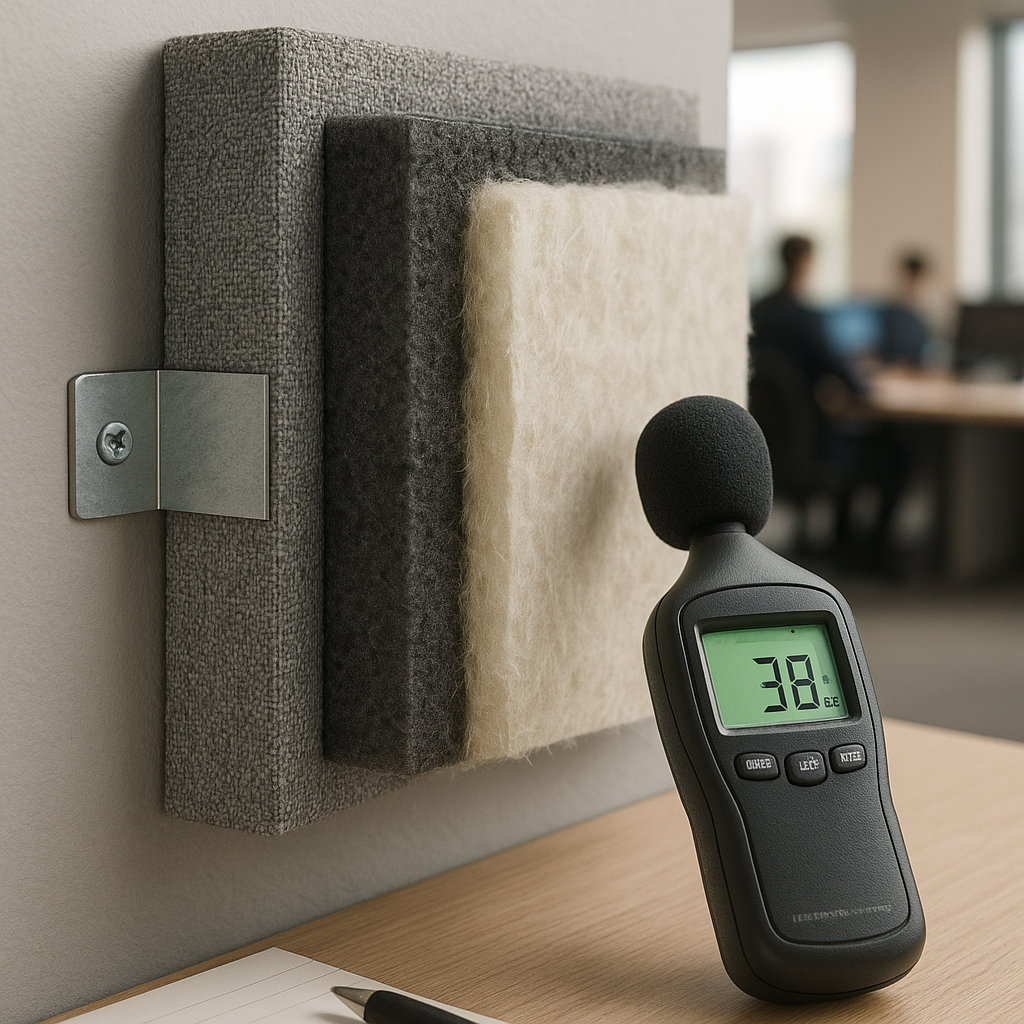
Acoustic ceiling tiles and wall panels are among the most effective tools for controlling reverberation. Modern acoustic panels are available in a wide range of materials, finishes, and forms — from mineral fibre tiles to fabric-wrapped baffles suspended from ceilings. These solutions can dramatically reduce reverberation time without compromising the visual character of a space.
Acoustic Carpet and Flooring
Flooring choice has a significant impact on office acoustics. Hard floors — polished concrete, timber, vinyl — reflect sound efficiently and contribute to higher noise levels and longer reverberation times. Acoustic carpet, by contrast, absorbs both airborne and impact sound. Research has shown that carpeted offices can exhibit reverberation times up to 50% lower than equivalent hard-floored spaces. Beyond reverberation, carpet also reduces the transmission of footstep noise, which is a common irritant in multi-storey buildings.
Sound Masking Systems
Sound masking involves introducing a low-level, engineered background sound — typically a soft, broadband noise resembling airflow — into the office environment. Rather than making things louder, masking works by raising the ambient noise floor to a level where speech from nearby conversations falls below the threshold of intelligibility. When implemented correctly, sound masking can significantly reduce the radius of distraction in open-plan spaces.
Zoning and Layout Planning
Acoustic zoning involves organising the office into areas with different noise expectations: quiet zones for focused work, collaboration zones for team discussion, and social zones where higher noise levels are acceptable. Physical barriers such as bookshelves, planters, and partial-height partitions can help define these zones without the need for full-height walls, while also providing some degree of acoustic separation.
Phone Booths and Quiet Pods
The rise of prefabricated acoustic pods and phone booths reflects a growing awareness that open-plan offices need enclosed spaces for calls, video meetings, and focused individual work. These modular solutions are typically designed with acoustic performance specifications and can be installed without permanent construction work.
The Open-Plan Office Debate
The acoustic challenges of open-plan offices have prompted a broader rethinking of workspace design. The open-plan model — popularised through the 1950s and 1960s and revived enthusiastically in the tech industry during the 2000s — was partly predicated on the idea that proximity and visibility would foster collaboration. The acoustic evidence has complicated this picture considerably.
A landmark study by Harvard researchers Ethan Bernstein and Stephen Turban, published in 2018, found that face-to-face interaction in open-plan offices actually decreased following the removal of physical barriers, with workers switching to electronic communication instead. Meanwhile, the noise and lack of privacy in such environments consistently score among the top complaints in workplace satisfaction surveys. These findings have become central to debates about how hybrid working is transforming workplace strategies and what organisations should demand from their office environments.
This doesn’t mean open-plan design is inherently flawed — but it does mean that acoustic performance cannot be an afterthought. Effective open-plan environments require deliberate acoustic engineering, not just aesthetic choices about furniture and flooring.
Future Directions in Workplace Acoustics
Acoustic science continues to evolve alongside changes in how and where people work. Several emerging areas are worth watching:
- Active noise cancellation at the room level: Technology already deployed in headphones is being explored for architectural applications, using speakers to generate anti-phase sound waves that cancel out specific noise sources.
- Biophilic soundscaping: Research into the restorative effects of natural sounds — water features, birdsong, rustling leaves — suggests that carefully designed soundscapes can reduce stress and improve cognitive recovery in workplace settings.
- AI-driven acoustic monitoring: Smart building systems are beginning to incorporate real-time acoustic monitoring, allowing facility managers to identify problem areas and adjust masking systems or alert occupants dynamically.
- Neurodiversity-informed design: As awareness of sensory processing differences grows, acoustic design is increasingly being approached with neurodivergent workers in mind — creating spaces with genuinely low-stimulation options rather than token “quiet rooms.”
Conclusion
Workplace acoustics sits at the intersection of physics, neuroscience, architecture, and organisational behaviour — a genuinely interdisciplinary field with practical consequences for millions of people every working day. The science is clear that sound environments profoundly shape cognitive performance, stress levels, wellbeing, and even interpersonal behaviour at work.
Effective acoustic design isn’t about achieving silence — it’s about creating the right sonic conditions for the tasks people need to perform. That involves understanding how sound travels and decays in built spaces, selecting appropriate materials and technologies, and planning layouts that respect different working modes. Metrics like reverberation time, speech transmission index, and spatial decay rate give designers and organisations objective tools for evaluating and improving acoustic performance.
As workplaces continue to evolve — with greater emphasis on flexibility, neurodiversity, and evidence-based design — acoustics is likely to move from a specialist concern to a mainstream consideration in how offices are planned and managed. The hum of a well-designed space, after all, is one that most people never notice — and that’s precisely the point.